Anúncios
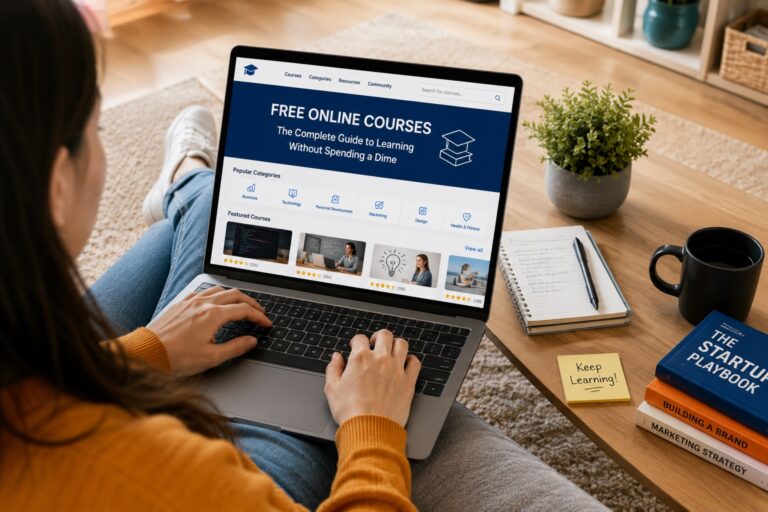
Access to quality education no longer depends on how much money you have in your pocket. Today, there are incredible platforms offering free online courses in areas such as programming, design, marketing, business, and languages, available to anyone in Latin America with an internet connection.
If you have always wanted to learn something new, improve your professional skills, or change careers, this is the perfect time. In this complete guide, we explain everything you need to know about Platzi, Coursera, edX, Google, and many other platforms that offer free, high-quality education so you can grow without spending anything.
Tudo sobre cursos online gratuitos
Free online courses have transformed the way millions of people learn around the world. From Latin America, thousands of students access content every day that was once available only at elite universities or cost thousands of dollars. Discover the main platforms and what they offer.
Platzi: the leading Spanish-language platform for Latin America
Platzi is one of the most popular and recognized educational platforms in Latin America. Founded in Colombia, it has become a favorite option for people who want to learn technology, business, and digital skills in Spanish.
Although Platzi is mainly a subscription-based platform, it offers a variety of free courses that you can take without paying anything. In addition, it regularly launches promotions, scholarships, and special access opportunities for students across the region.
| Categoria | Cursos em destaque | Nível |
|---|---|---|
| Programação | Python, JavaScript, React | Iniciante para avançado |
| Digital Marketing | SEO, Social Media, Email Marketing | Iniciante para intermediário |
| Design | Figma, UX/UI, Illustrator | Iniciante para avançado |
| O negócio | Entrepreneurship, Finance, Leadership | Iniciante para intermediário |
| Inteligência artificial | Aprendizado de máquina, ChatGPT, Ciência de dados | Iniciante para avançado |
One of Platzi’s biggest advantages is that all of its content is in Spanish, which makes learning much easier for people who are not fluent in English. Its instructors are active industry professionals, helping ensure that the content is current and relevant.
Coursera and edX: free access to universities around the world
Coursera and edX are two of the largest learning platforms in the world, with content created by universities such as Harvard, MIT, Stanford, and the University of Chile. Although many courses charge a fee for certificates, most can be audited completely free of charge.
This means you can watch the classes, access the learning materials, and complete exercises without paying. You only need to pay a fee if you want the official certificate, and in many cases the cost is relatively affordable for people in Latin America.
| Plataforma | Instituições parceiras | idiomas disponíveis | Certificado grátis |
|---|---|---|---|
| Coursera | Harvard, Stanford, Yale, University of Chile | Espanhol, Inglês, Português | No, free audit only |
| edX | MIT, Berkeley, Microsoft | Espanhol inglês | No, free audit only |
| Khan Academy | In-house content | Espanhol inglês | Yes, completely free |
| FutureLearn | University of Edinburgh, British Council | Inglês espanhol | Limitada |
Both Coursera and edX offer financial aid programs for people who demonstrate financial need. If you live in Latin America and cannot afford the certificate, you can apply for these programs and may be able to obtain it at no cost.
Google, Meta, and Microsoft: free certifications from major technology companies
The world’s largest technology companies also offer free training programs. Google, Meta, and Microsoft have launched initiatives designed to train millions of people in digital skills, especially in developing regions such as Latin America.
These programs are especially valuable because, after completing them, you may receive certifications recognized internationally by the companies themselves, which can help open doors in the job market. Below are some of the most important initiatives:
Certificados do Google: courses in data analytics, IT support, project management, digital marketing, and UX design, available through Coursera with scholarship options.
Meta Blueprint: free training in digital advertising, page management, Instagram, and social media business strategies.
Microsoft Aprenda: completely free courses in Azure, Power BI, Office 365, and software development, with recognized certification pathways.
Aprendizado do LinkedIn: offers a free trial period with access to thousands of courses in business, technology, and creative fields.
Complete guide: how to make the most of free online courses
Having access to courses is only the first step. The most important thing is knowing how to organize yourself, choose what to study, and make the most of each platform so that your learning is meaningful and leads to better professional or personal opportunities.
Como escolher o curso certo para seus objetivos
Before starting any course, it is essential to define what you want to achieve. Are you looking to change careers? Improve in your current job? Learn something out of personal interest? The answers to these questions will help you choose the right platform and course.
Once your goal is clear, research which skills are most in demand in your field of interest. Review job openings on LinkedIn, Computrabajo, or Indeed and write down the skills and knowledge employers request most often. This will give you a clear roadmap for your learning journey.
- Define a clear and specific goal before you start.
- Research the most in-demand skills in your field.
- Choose courses with good reviews that have been updated recently.
- Prefer platforms with certificates recognized by companies.
- Start with beginner-level courses if you are new to the subject.
The best free platforms by category
Not all platforms are the same or serve the same purpose. Depending on what you want to learn, some options may be better suited to your needs. Below are some of the best alternatives organized by category.
For programming and technology, some of the best free options are freeCodeCamp, The Odin Project, Harvard’s CS50 available through edX, Codecademy, and Platzi itself. All of them provide practical content and active communities where you can ask questions and connect with other learners.
For languages, Duolingo remains one of the most popular and gamified options, but you can also use BBC Learning English, italki, or British Council English courses available through FutureLearn. For business and personal finance, Khan Academy, Alison, and Coursera offer excellent free content.
How to organize your online studies without quitting halfway through
One of the biggest challenges with online courses is dropout. According to studies on online learning, only a relatively small percentage of enrolled students complete certain courses. The main reason is often not difficulty, but a lack of organization and personal commitment.
To avoid giving up, set fixed study times as if you were attending in-person classes. Dedicate at least 30 minutes a day to your course, turn off notifications, and find a quiet place to study. Taking notes in a notebook or using apps such as Notion can also help you retain what you learn.
- Set a fixed schedule and follow it as if it were an in-person class.
- Break the course into small, achievable weekly goals.
- Join study groups or online course communities.
- Apply what you learn to real projects from the beginning.
- Celebrate each milestone to stay motivated.
How to get free certificates that can help in the job market
Online certificates are becoming increasingly relevant in the Latin American job market, especially in technology and digital fields. However, not all certificates carry the same weight, so it is important to understand which ones may be more useful professionally.
Certificates from companies such as Google, Microsoft, Meta, and IBM, as well as programs offered by universities such as Harvard and MIT through edX and Coursera, are among the best-known options. Platzi certificates are also common among startups and digital companies in the region. Add your certificates to your LinkedIn profile after earning them so recruiters can see your qualifications.
- Prioritize certificates from Google, Microsoft, Meta, and IBM.
- Apply for financial aid on Coursera and edX to access paid certificates at a reduced cost or potentially for free.
- Look for programs that include practical projects you can showcase in your portfolio.
- Add your certificates to LinkedIn and keep your profile updated.
Scholarship programs and free access opportunities for Latin America
In addition to free courses available to everyone, there are special scholarship programs aimed specifically at people in Latin America. These initiatives seek to reduce the digital divide and provide access to quality education for those who need it most.
Some notable initiatives include Coursera programs developed in partnership with universities and institutions, Google.org initiatives for nonprofit organizations, and Platzi scholarship programs aimed at different groups and communities. There are also government initiatives in countries such as Mexico, Argentina, Colombia, and Peru that provide free access to educational platforms and professional training.
How to build a portfolio with what you learn in free courses
The certificate is important, but what often convinces employers most is seeing what you can actually do with what you have learned. That is why, while studying, it is essential to build a portfolio of real projects that demonstrate your skills.
If you study programming, upload your projects to GitHub. If you are learning design, create a profile on Behance or Dribbble. If you specialize in digital marketing, document your own campaigns on a blog or on Medium. A strong portfolio can be more valuable than multiple certificates when looking for a job or freelance clients.
- Apply each skill you learn to a real project from day one.
- Use GitHub for code, Behance for design, and Medium for written content.
- Document your learning process on social media to build your personal brand.
- Include personal projects in your portfolio, even if they are small.
- Ask mentors or online communities for feedback so you can continue improving.
Frequently asked questions about free online courses
Here are answers to some of the most common questions people have before starting their journey with free online education.
Are Platzi’s free courses really worth it?
Yes, Platzi’s free courses can offer high-quality content created by industry professionals. Although the free selection is more limited than the paid subscription, the courses available at no cost can be a good way to get started and evaluate whether the platform fits your learning style.
Can I get a job with only certificates from free online courses?
It is possible, but certificates alone are usually not enough. People in Latin America use certificates from Google, Platzi, Coursera, and edX to strengthen their professional profiles, especially in technology, marketing, and design. The key is to combine certificates with a strong portfolio of projects that demonstrates your real skills.
How long does it take to complete an online course?
It depends on the course and platform. Shorter courses from Google or Platzi may take a few weeks if you study regularly. More complete programs from Coursera or edX can take several months. The most important thing is to stay consistent and maintain a regular study routine.
Are there free courses in Spanish for Latin America?
Yes. Many platforms offer content in Spanish. Platzi focuses heavily on Spanish-language content, while Coursera, edX, and Khan Academy also offer many courses and learning materials in Spanish. Google and Meta provide several training resources adapted or translated for Spanish-speaking users.
How can I get a free certificate on Coursera or edX?
On Coursera, some courses offer financial aid that can reduce or eliminate the cost of access depending on eligibility and the specific program. On edX, many courses allow free auditing of learning materials, while certificates usually require payment. Some programs may also offer financial assistance or scholarships depending on the course and institution.